Examples
Purpose
Use this page after a successful install to look up the exact observation, action, reward, termination, configuration, and scene identity contracts for the three built-in example environments: CartPole, Ant, and HalfCheetah.
How to use this page
- Use Quick comparison to choose an environment and confirm its default vector sizes, reward-term count, and termination behavior.
- See the environment section for exact configuration defaults, flattened observation order, action bounds, reward terms, termination behavior, and scene identity.
- Read Environment Class API before slicing vectors or sending actions, and use its runtime inspection example when configuration variants can change a size.
Every environment also inherits the shared MochiEnvCfg fields documented in
Authoring a Custom Environment.
Quick comparison
| Environment | Observation | Action | Reward terms | Terminates? |
|---|---|---|---|---|
| CartPole | 4 | 1 | 1 | yes |
| Ant | 81 | 8 | 4 | yes |
| HalfCheetah | 17 | 6 | 2 | no |
CartPole
superdex_gym/CartPole-v0 · CLI cart_pole ·
superdex.lab.gym.envs.benchmarks.cartpole_env.CartPoleEnv
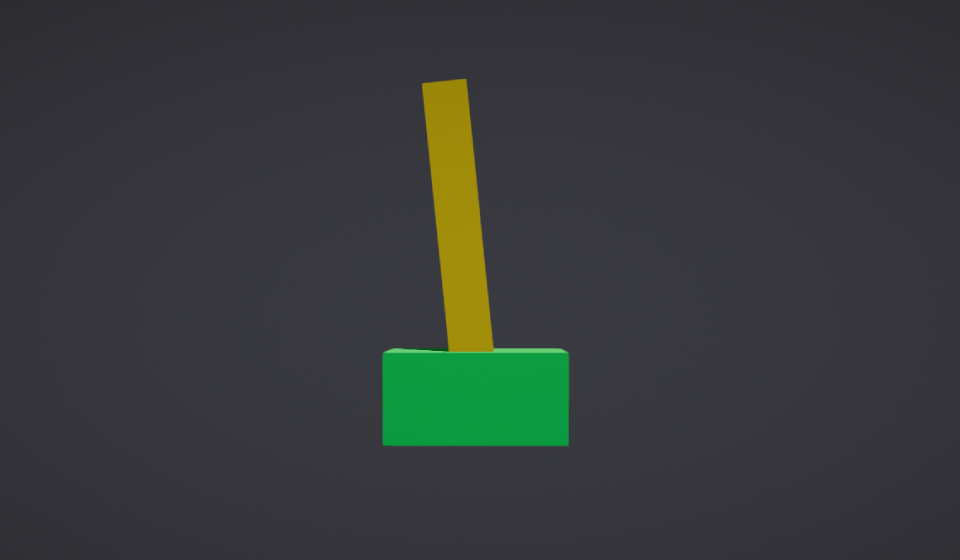
CartPole balances a pole on a cart moving along a linear rail. It is the smallest
environment and the best smoke test. It requires only the benchmark scene assets
(assets/benchmarks/cart_pole/) and no bot asset.
superdex-robotics package is required by every environmentAll environments require superdex-robotics, including CartPole and Ant. If its import
fails, follow Verifying the Install.
from superdex.lab.gym.envs.benchmarks.cartpole_env import CartPoleEnv, CartPoleEnvCfg

env = CartPoleEnv(CartPoleEnvCfg())
env.close()
Configuration
| Field | Default | Meaning |
|---|---|---|
control_frequency | 25 | Hz |
simulation_frequency | 50 | Hz — 2 substeps per control step |
steps_per_episode | 1000 | |
reset_noise_scale | 0.1 | |
render_control | True | Stored on the environment but currently unused |
actuate_on_pole | False | Apply the control force to the pole instead of the cart |
use_damping | True | Joint viscous friction |
use_gravity | True | |
free_pole | False | Remove the pole's joint limits |
Observation — 4 elements
| Key | Shape | Meaning |
|---|---|---|
angular_vel | 1 | Angular velocity of the pole (rad/s) |
linear_vel | 1 | Linear velocity of the cart (m/s) |
position | 1 | Cart position along the rail (m) |
vertical_ang | 1 | Vertical angle of the pole (rad) |
Listed in flattened order.
Action — 1 element
control, bounded [-3.0, 3.0], is scaled by 100 and applied as a linear force
on the prismatic cart DOF 0, or as a torque on the revolute pole DOF 1 when
actuate_on_pole=True.
Reward
One term, upright_reward: 1.0 while |vertical_ang| <= 0.2, else 0.0.
Termination
Terminates with terminated_reason = "Pole angle exceeded threshold" once the pole
leaves the upright band. Truncates at steps_per_episode.
Scene identity
uid_fields = (use_damping, use_gravity, free_pole) contains the three fields that
change how the prefab is built. When use_shared_scenes=True, environments in the
same process with matching values share one physics scene. Otherwise, each
environment creates its own scene.
Ant
superdex_gym/Ant-v0 · CLI ant · superdex.lab.gym.envs.benchmarks.ant_env.AntEnv
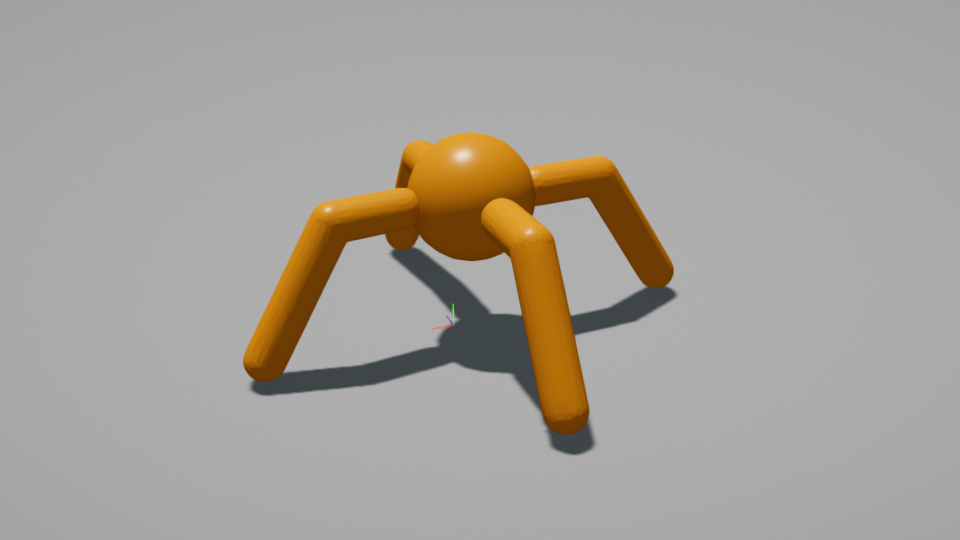
Ant provides quadrupedal locomotion. Its reward favors forward progress and penalizes control effort and contact-wrench magnitude.
Configuration
| Field | Default | Meaning |
|---|---|---|
control_frequency | 20 | Hz |
simulation_frequency | 100 | Hz — 5 substeps per control step |
steps_per_episode | 1000 | |
reset_noise_scale | 0.1 | |
forward_reward_weight | 1 | |
control_cost_weight | 0.5 | |
contact_cost_weight | 5e-4 | |
healthy_reward | 1.0 | Per-step bonus while healthy |
terminate_when_unhealthy | True | |
healthy_y_range | (0.2, 1.0) | Torso height band, in metres |
contact_force_range | (-1.0, 1.0) | Per-component clipping range for each body's contact wrench (force and torque) before the cost |
exclude_current_positions_from_observation | True | Omit x and z, keeping policies translation-invariant |
include_contact_in_observation | True | |
use_rotation_vector | False | |
use_damping | True | |
use_gravity | True | |
use_low_friction | False | |
use_high_friction | False | |
init_dist_from_ground | 0.55 | m |
init_ankle_angle | radians(57.30) | ≈ 1.0 rad |
Ant uses the plural field name exclude_current_positions_from_observation;
HalfCheetah uses the singular form.
Observation — 81 elements (default config)
| Key | Shape | Meaning |
|---|---|---|
contact_forces | 54 | Six contact-wrench components (force and torque) for each of 9 bodies. Omitted when include_contact_in_observation=False |
pose | 13 | num_dofs (14) - 2 for the excluded positions, +1 for the quaternion representation |
vel | 14 | One per DOF |
The table lists flattened order. Turning off
exclude_current_positions_from_observation adds 2, turning off
include_contact_in_observation removes 54, and setting use_rotation_vector=True
removes 1.
Action — 8 elements
control, bounded [-1.0, 1.0]. Applied as external forces on DOFs 6–13 with a force
scale of 150.
Reward — 4 terms
| Term | Value |
|---|---|
forward | x_velocity × forward_reward_weight |
ctrl | -control_cost_weight × control·control |
contact | -contact_cost_weight × ‖clipped contact-wrench vector‖² |
survive | healthy_reward while healthy, else 0 |
The scalar reward sums the four terms directly; ctrl and contact are already
negative.
Termination
Terminates with "Unhealthy" when the torso height leaves healthy_y_range, unless
terminate_when_unhealthy=False. Truncates at steps_per_episode.
Scene identity
uid_fields = (use_damping, use_gravity, use_low_friction, use_high_friction).
HalfCheetah
superdex_gym/HalfCheetah-v0 · CLI half_cheetah ·
superdex.lab.gym.envs.benchmarks.halfcheetah_env.HalfCheetahEnv
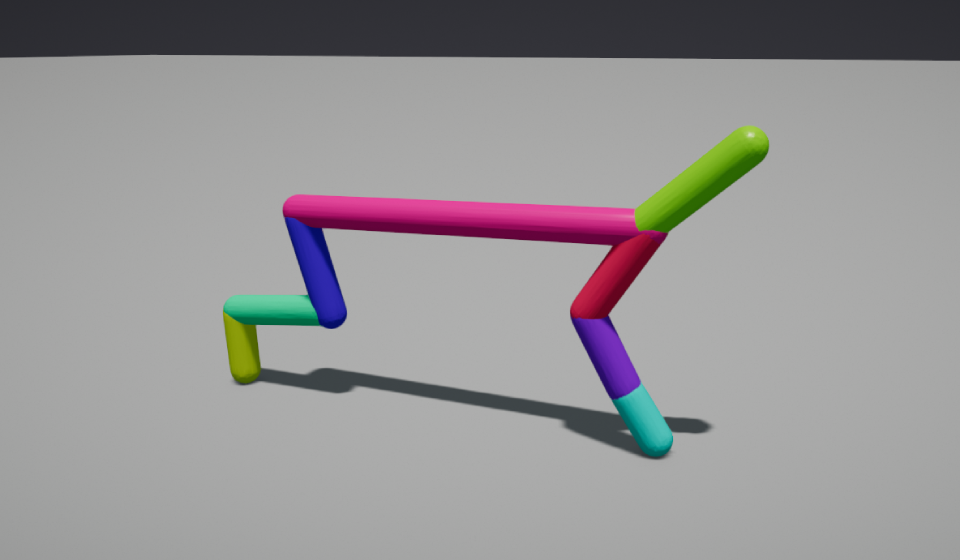
HalfCheetah provides planar (2-D) running. Its reward favors forward velocity and penalizes control effort.
Configuration
| Field | Default | Meaning |
|---|---|---|
control_frequency | 20 | Hz |
simulation_frequency | 100 | Hz — 5 substeps per control step |
steps_per_episode | 1000 | |
reset_noise_scale | 0.1 | |
forward_reward_weight | 1 | |
control_cost_weight | 0.1 | |
exclude_current_position_from_observation | True | Omit the x-coordinate |
use_gravity | True | |
use_rest_springs | True | Apply rest springs to the joints |
Observation — 17 elements (default config)
| Key | Shape | Meaning |
|---|---|---|
pose | 8 | num_dofs (9) - 1 for the excluded x-coordinate |
vel | 9 | One per DOF |
There is no contact observation.
Action — 6 elements
control, bounded [-1.0, 1.0]. Applied as external forces on DOFs 3–8 with
per-joint force scales [120, 90, 60, 120, 60, 30].
Reward — 2 terms
| Term | Value |
|---|---|
forward | x_velocity × forward_reward_weight |
ctrl | -control_cost_weight × control·control |
Termination
HalfCheetah does not override _check_stop_criteria. The base class only truncates at
steps_per_episode, so terminated is never True.
Scene identity
uid_fields = (use_gravity, use_rest_springs).